Yesteryear
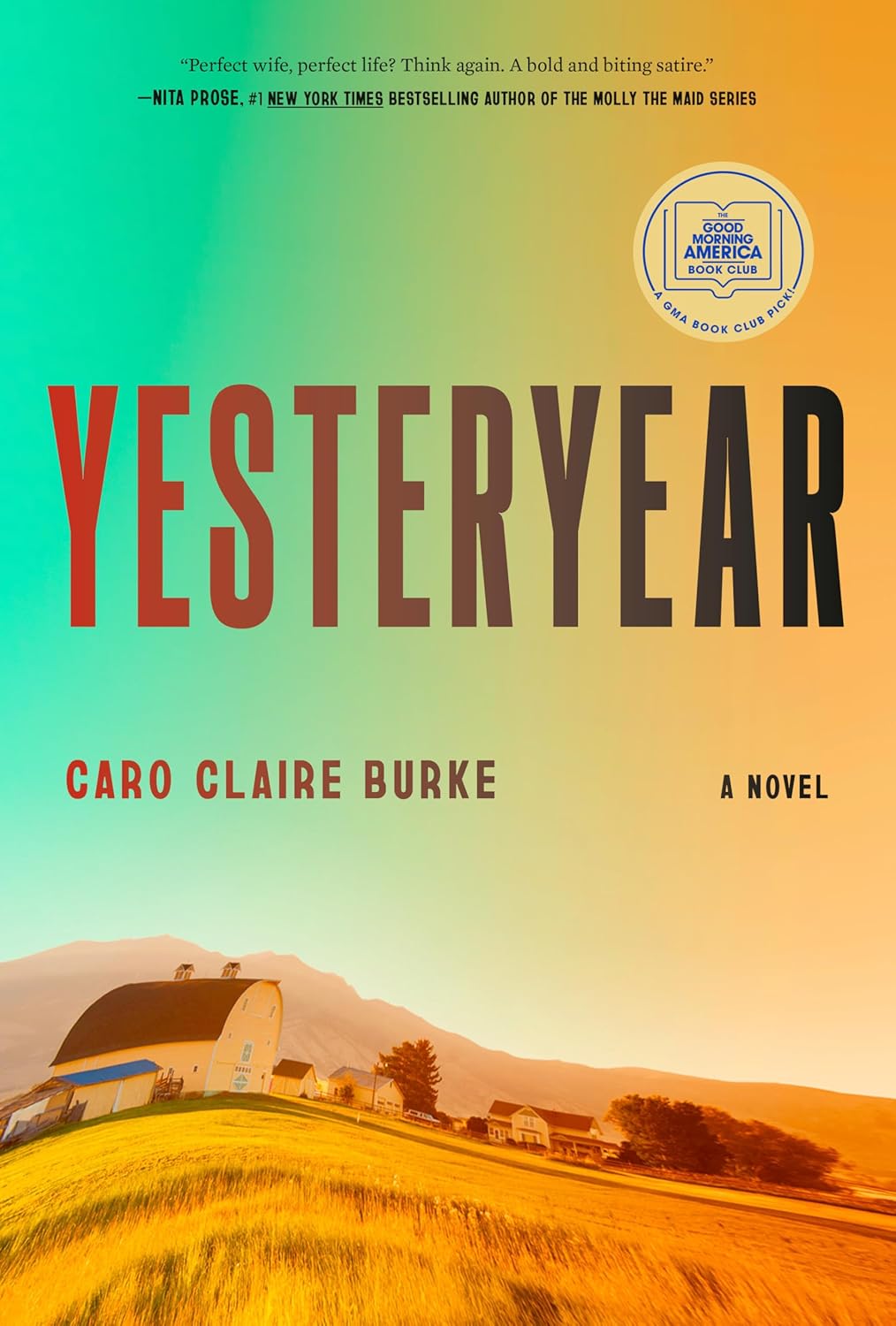
Author: Burke, Caro Claire
Tags: audio, satire, sarcasm
Timeline: between Tuesday, August 11, 2026 and Tuesday, August 25, 2026
Started this on a long road trip and wanted to to listen to something “current”.
The book starts with Natalie a famous social media influencer who lives on “Yesteryear” farm as a representative of the “tradwife” lifestyle and married to Caleb, pretend cowboy/farmer, heir to a powerful political dynasty; her family (Caleb and five kids) is in the midst of an incipient scandal: Caleb was sleeping with her young social media producer and the producer is now attacking the family in the media.
The next chapter in the book she is in an “old” version of her farm house and apparently it is 1850. She has no nice clothes and no modern appliances, new kids (we never learn what happened to the original five kids) and an apparently older version of Caleb. She freaks out because she thinks that this fake: she is being “gaslit” and so tries to run away. Caleb catches her and smacks her to show her who’s boss. Welcome to real yesteryear bitch!
The chapters of the book alternate between 1850 and modern day. In the modern day narrative we learn the back story: Natalie is raised Christian and is smart enough to go to Harvard where she is rejected, mocked for her conservative serious outlook. In lieu of graduating, she marries a naive, dilettante young man, Caleb, the youngest son in a very wealthy, politically conservative family. Searching for a way to settle down and make a living she uses her new family’s money to start a “traditional” farm. Failing at the farm and trapped in an unsatisfying marriage, Natalie becomes a social media influencer as a “Tradwife”. Some months into her social media influencer career she hires a young producer who while (apparently) very successfully improving her business results, at the same time is seemingly judging her and her family. Eventually this all returns to the situation described in the very first chapter.
In the 1850 narrative Natalie is miserable, fails at chores, fails at cooking, fails at parenting, has horrible clothing: tries a few times to escape, once having her ankle severely wounded (b/c no modern medicine in 1850!) and fails. Eventually when one of her children is dangerously sick, she finally escapes, only to discover that, in fact, 1850 is all fake and her previous sons live in a cabin a few miles down the road watching football on TV. Her original daughter shows up the next day to take away the new children because Natalie is a horrible mother and Yesteryear farm (with no modern medicine!) is dangerous.
Is this satire or sarcasm? Natalie the protagonist is an anti-hero I guess. The entire time, her monologue is punctuated by her sarcastic disdain for her husband’s family and other young women in her cadre who aspire to having a career or who do not marry into the privilege of wealth. Her disquisitions of disapprobation generally involve the word “cunt” and include an prayerful apology to the lord for her potty mouth. Natalie is not even one tiny bit likeable and I found myself rooting for 1850s Caleb to smack her again on several occasions.
Anyway, how did she wind up in fake-1850 and why doesn’t she understand that she is in fake-1850? That is the question that is never satisfactorily answered in this story. The book does hand wave at an answer: that Natalie with the cooperation of her family created old Yesteryear farm in the aftermath of the adultery scandal. But why did they create it (what problem is solved and/or how does it improve things?) and if they did why doesn’t Natalie know about it and what was going on before she “woke-up” in fake-1850? She forgot giving berth to four (four!) new children?!?!? And how can this book be super popular in the face of giant plot (black) holes? I don’t know and really, I don’t care.